Sports robots may repeat a drill for hours, track motion, or move equipment without tiring. The same system can injure a player, collect sensitive data, or change the contest if its role is poorly defined.
- Robots are most useful for repeatable training tasks and routine field work.
- Live play adds risks around impact, control failure, fairness, and data.
- A test plan should come before a purchase or public trial.
Where sports robots can help
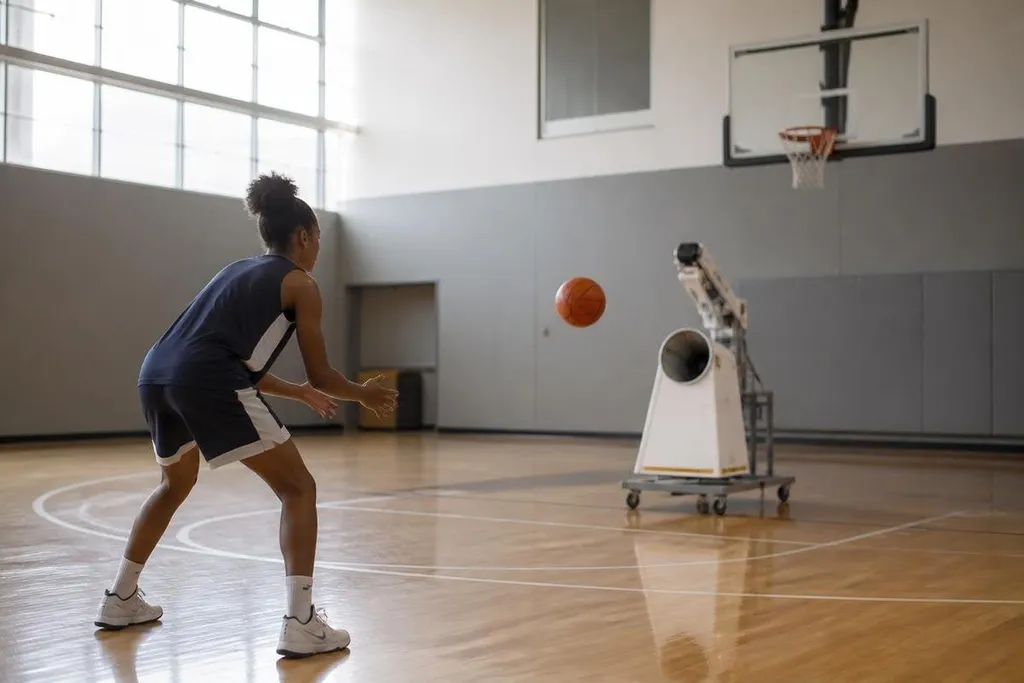
Training is the clearest place to start. The system can send a ball along the same path many times, hold a target at a set height, or repeat a movement at a chosen speed. That gives a coach a steady drill instead of one that changes with each human partner.
Repeatability matters when a player is working on timing. A coach can change one setting, such as speed or distance, and watch how the player responds. The robot’s value comes from that controlled change, not from making the session look more advanced.
Robots may also help with work around a venue. A mobile platform could carry equipment between marked areas, while a camera robot could follow play from a set route. Each task needs a clear human override, a safe stopping method, and a person responsible for the system during use.
The risks on the field
Physical contact is the first concern. A moving robot has mass, speed, motors, and hard parts that can strike a person. Risk rises when the system shares space with players, especially during drills that change direction without warning.
Control failure needs its own test. The system may lose a wireless link, read a person or ball incorrectly, or stop in a poor position. A safe design should bring the system to a controlled stop and make the stop command easy to reach.
Data creates another problem. Cameras and wearable sensors can record faces, movement, location, and health details. Teams need to state what they collect, who can see it, how long they keep it, and how a player can refuse recording when the rules allow that choice.
Fair play and access
Using a robot in practice can change what a player learns. If one team trains with a system that sends faster balls or gathers more motion data, its advantage may come from equipment rather than coaching. That does not make the robot unfair by itself, but the rules need to say where its use stops.
The same question applies during competition. A robot that acts as a referee, camera operator, or moving target can affect the match through errors in sensing or timing. Human officials still need a way to review decisions and pause the system.
Cost can shape access too. The price includes the robot, software, safety work, repairs, storage, and staff time. A low purchase price can hide a large operating bill if the system needs a trained operator for every session.
A sports robot’s trial should record its task, test date, operator role, and result, so the price reflects the work around the machine as well as the machine itself. Robot 24 can help you find reports with those details before the next section looks at what a useful trial should measure.
What a useful trial looks like
A trial should begin with one task and a limited area. Record the robot’s speed, stopping distance, control range, battery time, and failure response.
Test those points with the field empty, then repeat them with staff nearby before players take part. The team should also write down the cases that stop the trial.
A lost connection, damaged part, unclear warning, or unexpected movement needs a named response. If nobody knows who can stop the session, the trial has skipped its first safety task.
I’d keep a sports robot out of live play until its failure behavior is tested as carefully as its main skill.
A buying and trial checklist
Use these checks before the robot enters a sports setting:
- Name the task: Write the one job the robot must perform and the result that counts as success.
- Mark the space: Set physical limits for players, staff, spectators, and the robot.
- Test the stop: Check the emergency stop, wireless failure response, and restart process.
- Set data rules: List each sensor, its purpose, access rights, and storage period.
- Plan human control: Assign a trained operator who can pause the system at any time.
- Price the full use: Add staff, repairs, software, transport, power, and safety checks.
That checklist points to the next step: measure one narrow job before giving the robot a wider role. Its place on the field depends on useful work that can be shown, written limits, and a person who can stop it before a small fault becomes an injury.